
Contact: Jared Wadley, [email protected] Lauren Slagter, [email protected]
EXPERT Q&A
President Trump’s recent executive order to criminalize homelessness is the wrong approach that takes resources from those struggling to find long-term housing, according to a University of Michigan expert.
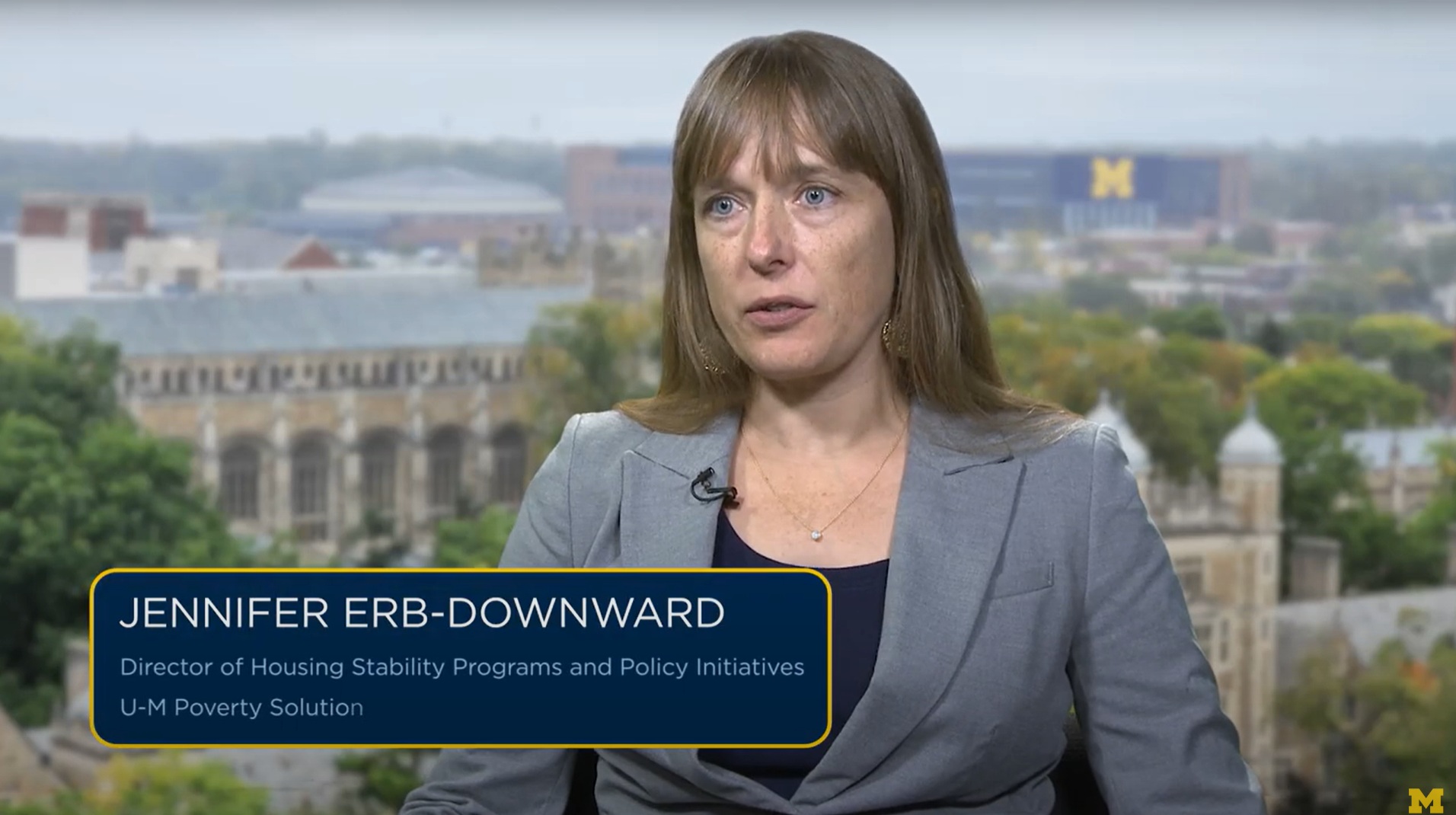
The measure isn’t a public safety matter, as promoted by the White House, but a tactic that hurts millions of people, especially homeless children who might struggle in school, said Jennifer Erb-Downward, director of housing stability programs and policy initiatives at U-M Poverty Solutions.
Critics argue the executive order on homelessness criminalizes poverty. Is there evidence that punitive approaches to homelessness work?
There is no evidence that I have seen that shows making it a crime to sleep on the streets or in other public spaces ends homelessness. Policies that criminalize homelessness just remove unhoused people from public view by locking them away. Not only does that not address the causes of homelessness, but it is also much more expensive than investing in the type of housing and services that research has shown are effective at creating long-term housing stability for unhoused people.
What alternative, evidence-based approaches to reducing homelessness exist—and how do they compare in cost and effectiveness to Trump’s executive order?
To date, the most effective evidence-based program to end homelessness and create long-term stability for unhoused people is the Housing First model. This approach provides housing without preconditions of sobriety or mental health treatment and then goes on to provide supportive services to meet the goals and needs of clients. Housing First has been shown to provide long-term stable housing and also to better enable individuals to address addiction, mental and physical health issues that had contributed to housing instability. The issue has never been that Housing First is not effective or that we do not have an evidence base for what works. The issue is that Housing First has never been fully funded to meet the actual need in the U.S. The irony here is that what the executive order calls for will be more expensive than fully funding a housing-first approach. Incarceration and forced institutionalization are incredibly costly in addition to being cruel and being ineffective approaches to ending homelessness.
Can you describe the potential financial cost of criminalizing street homelessness versus providing housing and support services?
Institutionalization of people is incredibly expensive and does not solve the ultimate issue that people need a place to live. Unless we provide people with another option than living on the street, as soon as they exit in whatever institution they have been placed in, they will return to being homeless. Just to put a ballpark cost on what we are discussing, estimates of the average cost of incarceration per person are $33,000 annually. The average cost to hospitals for an inpatient mental health or drug treatment stay is $7,100 for just six days—and again, what happens to people when they leave? By comparison, the estimated annual per-household cost of providing housing and services using the Housing First model ranges from about $8,500 to $20,000, depending on the level of support needed. So fully investing in housing and supportive services for unhoused people is significantly less expensive on an annual basis.
How might cities respond legally or politically to homelessness? Are there precedents for local or state governments resisting federal mandates?
Right now, organizations focused on the rights and well-being of people who are unhoused are reviewing the legality of all aspects of the executive order. There will likely be challenges to the order in court. Specifically, the language around forced commitment into mental health and drug treatment programs looks like it runs counter to current legal precedent that, for the last 26 years, has guaranteed people with disabilities the right to live in the community with needed support rather than be institutionalized. In terms of resistance at the state and local level, ultimately, how much street homelessness is criminalized will depend on the degree to which people choose to cooperate with and enforce these orders. We have seen examples of this type of resistance in some community responses to the executive orders on immigration.
How would this plan affect groups experiencing homelessness who are overlooked in broad policy debates?
One group that is often overlooked in policy conversations is homeless youth. An estimated 4.2 million youth and young adults experience homelessness annually, and many are survivors of sexual and physical abuse and human trafficking. Policies that criminalize homelessness—like the executive order does—will push youth into more dangerous situations and increase their risk of exploitation. Arrests made for sleeping on the street will create criminal records for youth that exacerbate existing challenges to finding stable employment and housing. Long term, these policies that criminalize homelessness will make it much harder for youth to access the support that they need to exit homelessness.
An op-ed that you wrote highlights that the president’s 2026 federal budget proposal would eliminate dedicated funding for the federal program that guarantees education protections and services for more than 1.4 million students experiencing homelessness. Describe what happens without the McKinney-Vento Act protections.
Without the protections that the McKinney-Vento Act provides, children experiencing homelessness will struggle to participate in school. Document requirements, such as proof of address, will delay or prevent students from enrolling in school. Children who move as a result of housing instability will be forced to transfer schools mid-year and school attendance will decrease as children no longer have access to transportation support. In the face of these greater challenges, without the McKinney-Vento Act protections, children will also no longer have the support of school liaisons who currently work to connect students and families with needed resources. The net result of losing these protections will be that more children experiencing homelessness will be denied their right to an education, and we will see more students unable to graduate from high school. This is why preserving the McKinney-Vento Act is so important; it ensures that being homeless as a child does not determine the course of the child’s education or future.
[embed]https://youtu.be/R20qwnn2zJo?si=dlOf1d4rxmSGUoXE[/embed]