
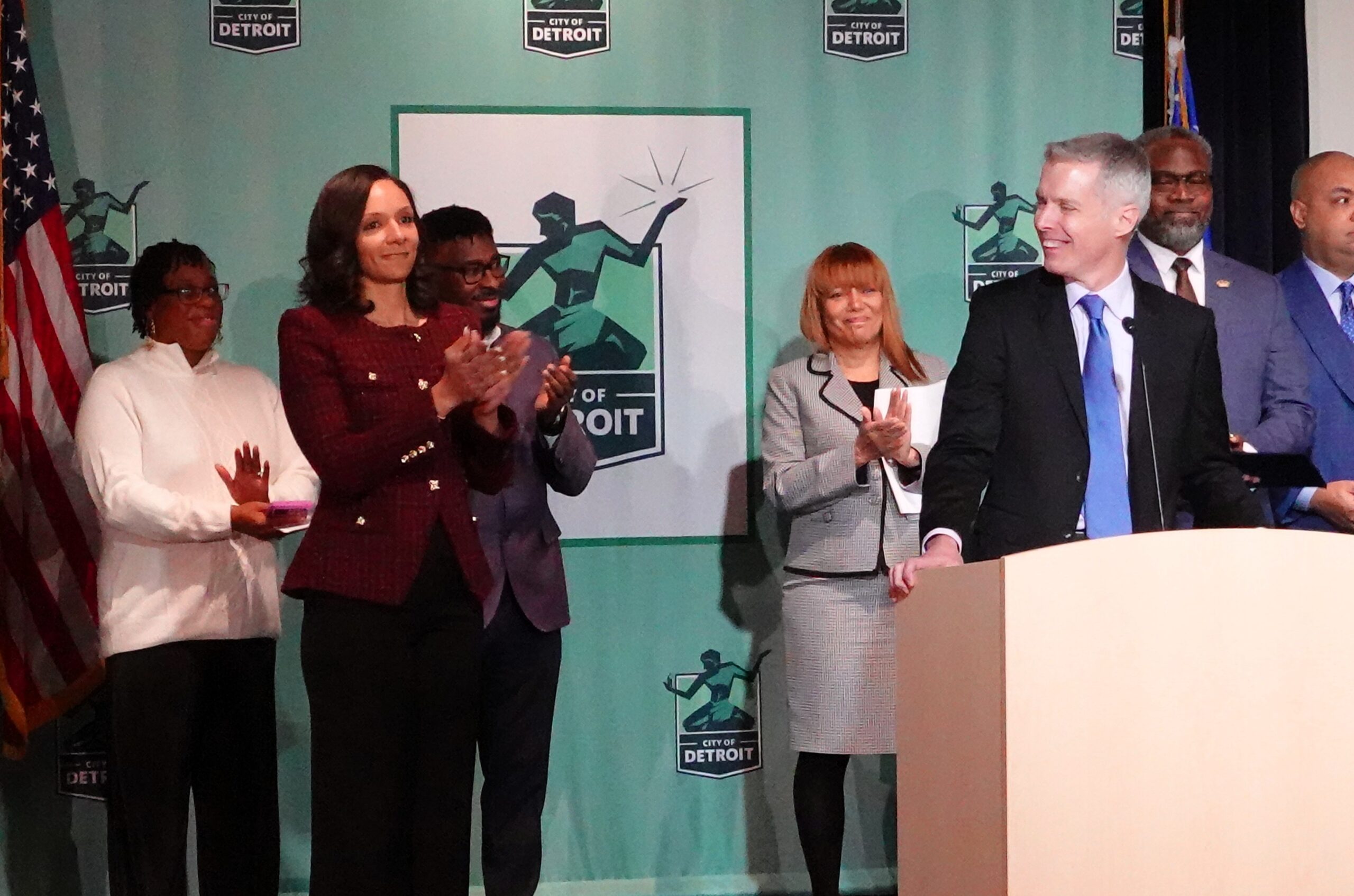
Detroit Mayor Mary Sheffield announces Luke Shaefer as chief executive of Health, Human Services, and Poverty Solutions for the City of Detroit at a press conference at Detroit Public Safety Headquarters on Jan. 12, 2026.
Kristin Seefeldt to serve as faculty director of Poverty Solutions at U-M
Contact: Lauren Slagter, [email protected]DETROIT – University of Michigan public policy professor Luke Shaefer has been named Chief Executive of Health, Human Services, and Poverty Solutions for the City of Detroit as part of Mayor Mary Sheffield’s incoming administration.
The new Chief Executive role is part of the city government’s reorganization plan aimed at improving quality of life and facing health inequities and homelessness head-on with revised strategies and approaches. It also reflects Sheffield’s commitment to a unified, community-centered approach that integrates public health, human services, and homelessness response.
Starting in February, Shaefer will oversee the Detroit Health Department, the Office of Immigrant Affairs and Economic Inclusion, and a new Department of Human, Homeless and Family Services directed by Benita R. Miller. Shaefer will take a two-year leave from U-M to take on this role with the City of Detroit, with plans to return to his faculty post.
“Confronting poverty has been Luke’s life work, and now he brings that passion, expertise, and national leadership right here to the City of Detroit,” Sheffield said at a press conference on Monday. “As the Chief Executive of Health, Human Services, and Poverty Solutions, Luke will bring data-driven, city-wide strategy focused on poverty, service gaps, and systemic barriers that prevent families from achieving stability.”

As the inaugural faculty director of Poverty Solutions at U-M, Shaefer has worked closely with the City of Detroit for years to set an economic mobility policy agenda for the city and leverage U-M’s expertise and resources to improve the well-being of Detroiters. Under Sheffield’s leadership, the City of Detroit will renew and expand the Detroit Partnership on Economic Mobility with U-M Poverty Solutions.
Poverty Solutions is a U-M presidential initiative that launched in 2016 to partner with policymakers and communities to find new ways to prevent and alleviate poverty through interdisciplinary, action-based research.
In addition to leading Poverty Solutions, Shaefer is the Hermann and Amalie Kohn Professor of Social Policy and Social Justice at the Gerald R. Ford School of Public Policy, professor of social work, and a faculty affiliate of the Survey Research Center and Population Studies Center at U-M’s Institute for Social Research. He has served on the faculty at U-M since 2008 and previously served as associate dean for academic affairs and associate dean for research and policy engagement at the Ford School.
From 2019-2021, Shaefer acted as a special counselor on anti-poverty policy to the director of the Michigan Department of Health and Human Services (MDHHS), during which time he partnered with agency leadership on policy innovations such as MDHHS’s unique Energy Direct program that saved tens of thousands of Michiganders from utility shut off and the state’s highly-successful COVID eviction prevention program.
His research, including his award-winning book, $2.00 a Day: Living on Almost Nothing in America, informed the design of the federal 2021 expanded Child Tax Credit that brought child poverty to a historic low. He is the co-founder of Rx Kids, the nation’s first community-wide prenatal and infant cash prescription program now active in communities all over Michigan.
“Luke Shaefer’s appointment with the City of Detroit is a wonderful recognition of his deep commitment to partnership and public service,” said Celeste Watkins-Hayes, dean of the Gerald R. Ford School of Public Policy. “Luke’s leadership at Poverty Solutions built meaningful collaborations across campus and with the Detroit community, advancing research that informs real-world solutions to pressing challenges. Through his work as the Hermann and Amalie Kohn Professor of Social Justice and Social Policy at the Ford School, Luke has played a leading role in advancing the Kohn Collaborative for Social Policy — a community of scholars, students, and practitioners dedicated to using rigorous, interdisciplinary research to confront inequality and inform policy change at Michigan and beyond. We’ll miss Luke in the halls and classrooms of Weill Hall, but are so excited to see all he will accomplish for Detroit.”

Kristin Seefeldt, who currently is senior associate faculty director at Poverty Solutions, will serve as faculty director of the research initiative; her appointment runs through December 2026. Seefeldt joined Poverty Solutions in 2019 and was acting faculty director for the 2024-25 academic year while Shaefer was on sabbatical.
“I am immensely proud of both Luke and Kristin as they step into these important new roles,” said Valeria Bertacco, vice provost of engaged learning, who oversees Poverty Solutions. “Luke’s appointment is a testament to his unwavering commitment to serving Detroit, and Kristin’s transition builds on her proven leadership and vision. Together, their partnership promises not only continued collaboration, but also expands our opportunities to foster positive change, now and in the years ahead. Their dedication ensures meaningful progress for Detroit and sets a strong foundation for future impact."
Seefeldt is an associate professor of social work and worked at the National Poverty Center housed at U-M, which later evolved into Poverty Solutions. Natasha Pilkauskas, an associate professor of public policy, joined Poverty Solutions – with its staff of 16 – as associate director of faculty engagement in the fall of 2025.
“It has been a pleasure to work alongside Luke in my years at Poverty Solutions, and his legacy will continue to live on here,” Seefeldt said. “Luke’s dedication to building Poverty Solutions and his commitment to engaging in work that will have real, positive impact on families’ lives is truly inspirational. Poverty Solutions remains committed to assessing the impact of public policy decisions and helping people make sense of what the evidence base points to as the best ways to prevent and alleviate poverty.”