
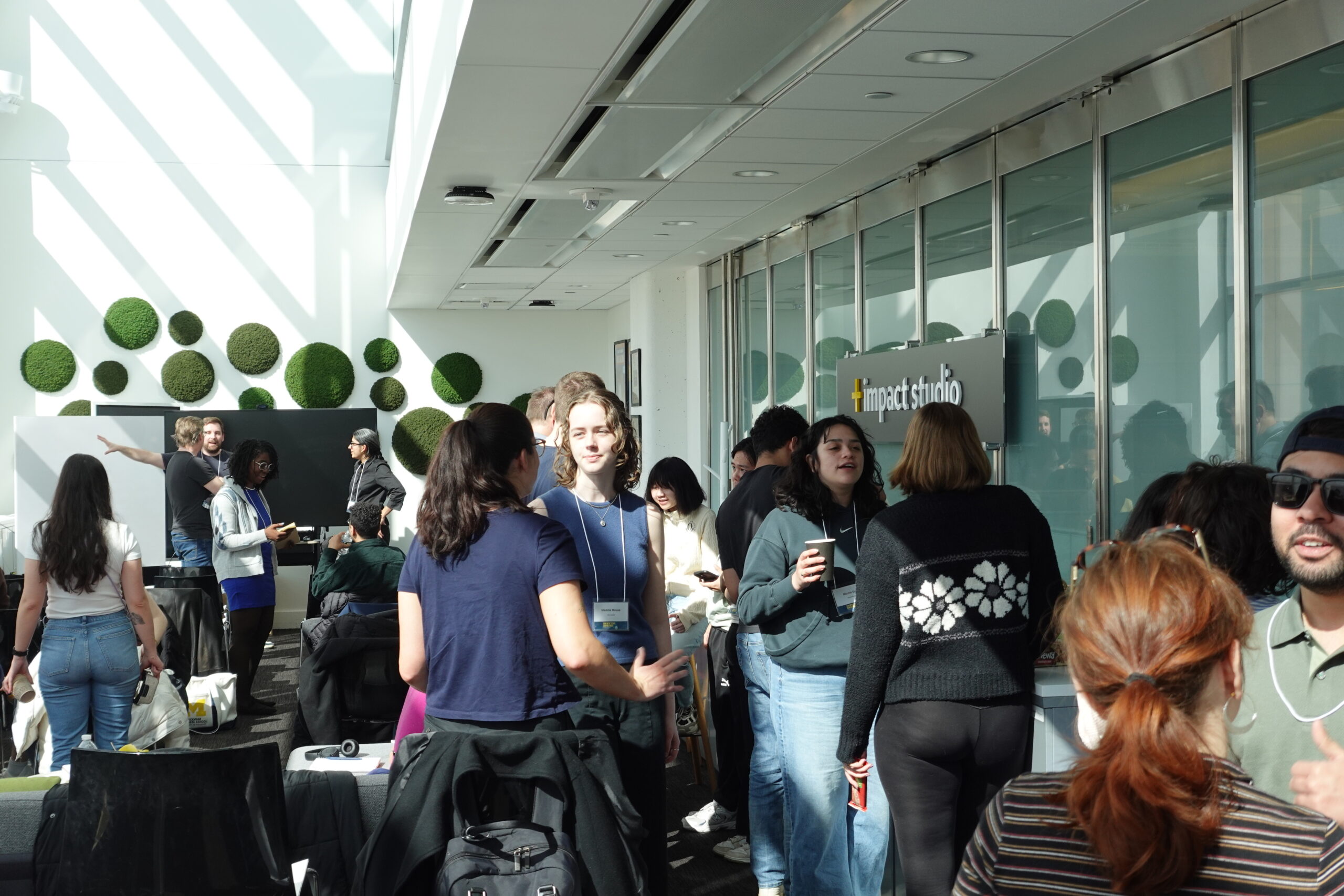
Small groups of people gathered around white boards with post-it notes in hand to brainstorm ideas for how to make government services work better by listening to people typically on the margins of policymaking.
It was a sunny day in the Impact Studio on the University of Michigan’s Ann Arbor campus, where 50 students, staff, and faculty from 10 different schools and colleges came together for a workshop led by Public Policy Lab (PPL), titled "Transforming Government Services with Human-Centered Design."
Building on previous student-led civic design workshops hosted by Poverty Solutions at U-M, this workshop on March 28 was spearheaded by Lauren Parker, a Master’s of Public Policy student (‘26) at the Gerald R. Ford School of Public Policy.
Former Poverty Solutions Student Engagement and Outreach Manager Trevor Bechtel, who worked closely with Parker to plan the event, interviewed her about how she developed the concept for the service design workshop and brought it to fruition. This is an edited version of that conversation.
What inspired you to host this workshop?
Parker: Last summer, while back home in the San Francisco Bay Area, I met with Sophia Kittler, a Ford School alum who is the current budget director and former director of innovation at the City of San Francisco. During our conversation, I shared that throughout my first year at Ford, I had become increasingly interested in the intersection of health policy, caregiving, process improvement, and human-centered design. I asked Sophia if she had any suggestions on how to combine these somewhat varying interests. She responded that to her, it seemed like I was describing "service design." I had yet to hear of the term "service design" and, after poking around on the internet, realized this was a sector I wanted to learn more about once I returned back to Ann Arbor in the fall.
Why did you reach out to PPL?
Parker: After perusing the U-M course catalog and failing to identify a graduate course on service design, I reached out to Bryan Boyer, associate professor of practice in architecture and director of Bachelor of Science in Urban Technology (UT) degree at Taubman College of Architecture and Urban Planning. A few of the undergraduate UT courses incorporated service design, and I thought Bryan would have a recommendation for a graduate-level course. Bryan shared that the only courses offered that semester were limited to UT students, however, he also shared that he is a board member of the Public Policy Lab and wondered if Ford students would be interested in some type of introduction to service design workshop. Based on previous conversations in some of my classes, and after a few informal conversations with folks in my cohort, I felt confident there would be substantial interest in this workshop. I was especially excited about this possibility as I had been following PPL for some time and was impressed with their approach, as well as The People Say, a qualitative database designed by PPL to help policymakers hear the voices of the public when shaping policy.
As an attendee of the April 2025 Eviction Policy & Design Workshop organized by Poverty Solutions, Rachael Zuppke, and Scott TenBrink, I thought Poverty Solutions might be willing to explore this idea and help the PPL workshop come to life. I worked closely with Trevor Bechtel and PPL to hone in on the workshop content, identify co-sponsors from across the university, and secure a physical space to host the workshop. After learning about a civic tech convening being planned the day before this workshop, Trevor and Poverty Solutions were also essential in helping us collaborate with Ron Bronson, the organizer of that event, and the Kohn Collaborative for Social Policy to turn this standalone workshop into a full Service Design weekend.
Related: Service Design Weekend allows students to re-imagine government

What were your goals for the workshop?
Parker: One of my goals was to provide an opportunity for students, faculty, and staff to gain a foundational understanding of service design and learn how human-centered design processes can be incorporated into government. Since service design is an inherently interdisciplinary pursuit, I also hoped this workshop would bring together students, faculty, and staff from across the entire university, to broaden the expertise present in the workshop and bridge academic silos.
As public policy students, we're taught how to propose and evaluate policies from a macro-level perspective, often emphasizing quantitative research findings. PPL's workshop provided an important complementary framework that prioritizes hearing directly from and co-designing programs with constituents who have been historically marginalized and systematically excluded from the policy-making process. In organizing this workshop, I hoped students would see how decisions made during implementation have direct material impact on constituents and learn the power that creative and human-centred approaches hold in designing services.
I was very proud of how the workshop came together, which welcomed close to 50 students and faculty from over 10 schools. Throughout the day, we were able to hear from individuals with limited access to basic needs and, with PPL's guidance, intentionally incorporate these perspectives as we engaged in the implementation design portion of the policy-making process.
How will you use principles from human-centered design in your work after graduation?
Parker: I’d love to work in a role where I can serve as a liaison between policymakers, government employees, and service designers. Regardless of where I end up, I hope to incorporate human-centered design’s emphasis on curiosity, focus on process, and recognition that centering the perspectives of those receiving and administering public services are essential to improving systems.