
By Lauren Slagter Poverty Solutions
Since its launch in 2016, Poverty Solutions at the University of Michigan has built an action-based research program that has informed efforts to prevent and alleviate poverty in Michigan and across the country.
“We know scholars don’t have all the answers, and yet we have an important role to play. We can bring data, evidence and analysis to identify critical issues and evidence-based solutions,” said H. Luke Shaefer, founding faculty director of Poverty Solutions, the Hermann and Amalie Kohn Professor of Social Justice and Social Policy, and a professor of public policy and social work.
“What we care most about is whether our work fosters change that empowers families. Our record on this is what I am most proud of.”
Poverty Solutions has leveraged the expertise of hundreds of faculty affiliates across the university, utilized staff-led research, and involved hundreds of students in its work to better understand and address the systemic causes of poverty.
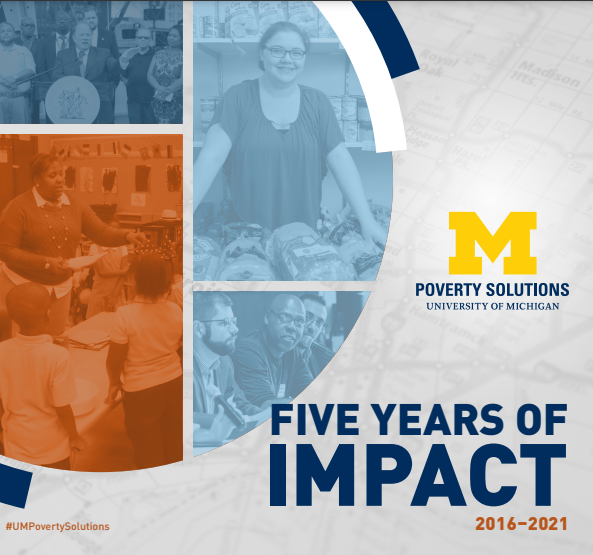
Its five-year impact report, released this week, summarizes efforts to:
- Strengthen the cash safety net during the COVID-19 pandemic to reduce hardship.
- Build a path to safe and stable housing for all Detroiters.
- Address student homelessness amid the pandemic.
- Cross-campus projects, including faculty grants and the annual Real-World Perspectives on Poverty Solutions Speakers Series.
- Washtenaw County initiatives, such as the SummerWorks youth employment program and the Opportunity Index.
- Detroit partnerships, like the Detroit Partnership on Economic Mobility and the Detroit Metro Area Communities Study.
- State-level collaborations, including advising the Michigan Department of Health and Human Services and addressing child poverty in Emmet County.
- National engagement, such as having four Poverty Solutions scholars testify at U.S. Congressional hearings.
“Structural racism and its effects are deeply embedded in both the causes and consequences of poverty, and we need to pay particular attention to this when designing and promoting solutions.”
Poverty Solutions will continue to foster an interdisciplinary approach to poverty alleviation, train the next generation of leaders working to eliminate poverty, and deepen partnerships with community organizations and policymakers to ensure the initiative’s research is responsive to real-world needs and has practical application.
“The pandemic put a spotlight on the underlying disparities in our society that contribute to poverty,” said Mara Ostfeld, associate faculty director at Poverty Solutions and assistant research scientist at the Gerald R. Ford School of Public Policy. “Our communities have faced profound challenges over the past few years, and we hope to expand our partnerships to address these challenges together.”