
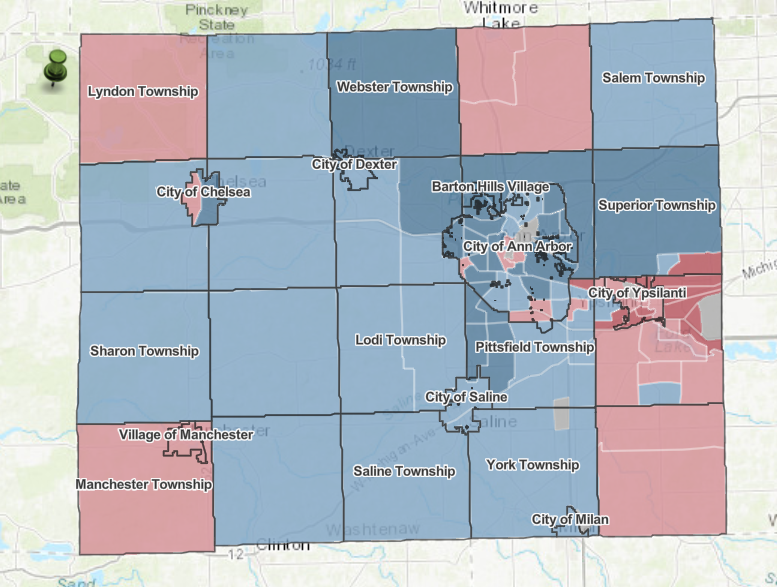
With about half of Washtenaw County’s $71 million in American Rescue Plan Act funds allocated, U-M researchers evaluated the county’s spending priorities to offer new insights on strategies to maximize long-term impact and promote equity with the one-time spending.
The American Rescue Plan Act of 2021 provides $350 billion in federal funding for state and local governments to assist with pandemic recovery for small businesses, households and hard-hit industries, and replace lost revenue for government services. Washtenaw County has received the $71 million over two allotments in May 2021 and May 2022, and the county’s Board of Commissioners has voted on how to spend $36 million of the funds so far.
“These funds will be substantial in aiding the county’s pandemic recovery efforts. With more money to be allocated and distribution decisions still undetermined, this is an opportunity to maximize the impact of the ARPA funds to increase equity within Washtenaw County,” said Amanda Nothaft, senior data and evaluation manager at Poverty Solutions and author of the policy brief, “One-time Spending for Long-term Impact: Evaluating Washtenaw County’s American Rescue Plan Act Allocations.”
While Washtenaw County boasts high levels of educational attainment, relatively high incomes and good health outcomes, these overall metrics hide wide disparities in outcomes for residents in different parts of the county. Access to opportunity in Washtenaw County is often tied to race and place.
Poverty Solutions partnered with the county’s Office of Community and Economic Development to revamp the Washtenaw County Opportunity Index, which combines 16 indicators into five categories of opportunity—health, job access, economic well-being, education and training, and community engagement and stability—to identify which parts of the county experience the highest and lowest levels of access to opportunity.
Washtenaw County commissioners formally committed in 2021 to use the Opportunity Index to apply an equity lens to their decision making and county initiatives. ARPA funds provide a unique opportunity to bolster the county’s current efforts to eliminate gaps in opportunity and promote equity, Nothaft said.
The policy brief offers an evaluation of Washtenaw County’s current ARPA allocations, which include:
- Navigation and financial assistance to help families find child care
- Creation of Children’s Savings Accounts for all public school students
- Broadband expansion
- Expanding access to home weatherization services
- Investing in the Washtenaw County Health Department
- Launching a Mobile Support Services Initiative
- Creating a Community Priority Fund to provide funding to organizations serving communities with low access to opportunity that were hit hard by the pandemic
Distributing ARPA money via grants and in partnership with community organizations should include a process to ensure the recipients have the capacity and track record to accomplish what they propose and that their interventions are backed by evidence and have measurable outcomes.
According to the policy brief, the goals of closing gaps in educational, economic and health outcomes by bringing services to people in need and providing funding to organizations that work within the community can only be met if these programs are fully funded and carefully implemented.