
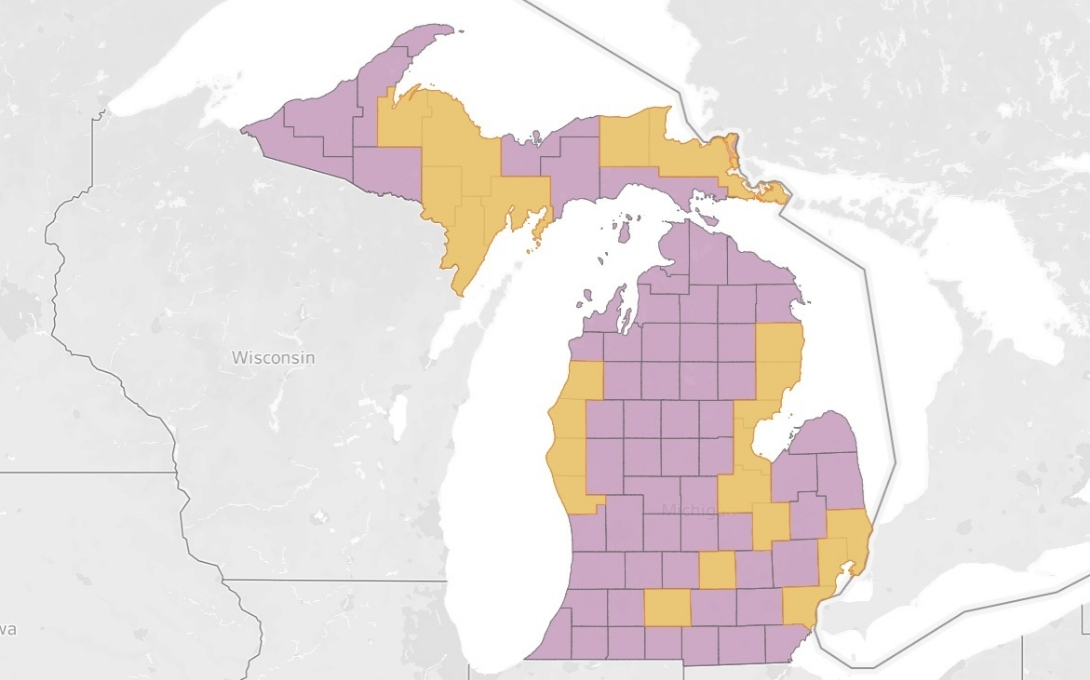
Michigan has recently experienced a notable 41% decrease in the number of opioid overdose deaths, from 2,287 in 2023 to 1,342 in 2024. While this is encouraging news, there are still "hotspots" within the state where opioid-related crisis indicator rates have been and continue to remain higher than other parts of the state.
The University of Michigan's Poverty Solutions and Overdose Prevention Engagement Network (OPEN) have released an update to the Michigan Opioid Map and white paper that looks at trends within opioid use hotspots. These resources highlight county-level socioeconomic and health-related data alongside indicators related to opioid use disorder, such as EMS response rates and opioid-related hospitalizations. Statewide,
The first iteration of the map and white paper examined 2019 data, with a second iteration released last summer examining 2023 data. Now, a third iteration looks at the latest data to shed new light on four previously identified hotspots:
- Bay County Region (Alcona, Iosco, Arenac, Bay, Saginaw, and Genesee counties),
- Marquette County Region (Baraga, Marquette, Dickinson, Delta, and Menominee counties),
- Wayne-Macomb-St. Clair Counties Region, and
- Muskegon to Manistee Region (Muskegon, Oceana, Mason, and Manistee counties).
UPDATES TO BAY COUNTY REGION
In 2022, Genesee and Iosco counties led Michigan in overall age-adjusted fatal opioid overdose rate. According to the new data, Genesee County remained the second highest county, and Saginaw County jumped up to third. Encouragingly, Iosco County dropped out of the top 10 counties in this category.
Also notably, Genesee and Saginaw counties saw a sizable decline between 2023 and 2024 rates for fatal synthetic opioid overdose deaths per 100,000. Of the remaining counties in this cluster, only Bay County had enough fatal overdoses to calculate an overdose rate per 100,000.
A significant socioeconomic change seen in this county cluster was that every county saw a decrease in its unemployment rate. Genesee County still led this hotspot between 2023 and 2024, while Bay County had the lowest unemployment rate.
UPDATES TO MARQUETTE COUNTY REGION
Baraga County continues to see high rates of naloxone administration compared to other Upper Peninsula counties, with a rate of 144 per 100,000 this year. However, as of 2025, Chippewa County's rate was even higher at 152 per 100,000.
Also in 2025, Chippewa and Luce counties were the highest rated counties in the state for the rate of EMS responses for probable opioid overdose per 100,000. Both counties saw an increase in this rate compared to 2024. No other counties in the Marquette County hotspot were in the top 15 for this metric.
On a positive note, the rate of unemployment for each county in the Marquette County hotspot decreased between 2024 and 2025.
UPDATES TO WAYNE-MACOMB-ST. CLAIR COUNTY REGION
In 2024, Wayne and Macomb counties alone accounted for 46% of the entire state's fatal synthetic opioid overdoses, with 35% in Wayne County and 11% in Macomb County. Importantly, Wayne and Macomb counties are two of the top three most populated Michigan counties, offering some explanation for the greater burden in cases.
Wayne, Macomb, and St. Clair counties all saw the rate of fatal synthetic opioid overdoses decrease in 2024 compared to their 2023 rates, despite all still remaining in the top 10 counties in Michigan for this category. It is also important to note that in 2024, the rest of the top 10 counties in Michigan saw a decrease in this rate as well.
Wayne county dropped from the top-rated county for EMS responses to probable opioid overdoses in 2024 to third in 2025, while Macomb and St. Clair counties remained outside the top 10 in this category.
Examining the rate of people experiencing a period of mental distress, Wayne and St. Clair counties each saw slight increases compared to 2023, while Macomb County had a decrease. Unemployment rates saw very little to no change between years, with the biggest difference in St. Clair County, down from 6.4% in 2023 to 5.7% in 2024.
UPDATES TO MUSKEGON TO MANISTEE COUNTY REGION
Previous analysis discovered a new hotspot that included Muskegon, Oceana, Mason, and Manistee counties. Based on analysis of the rate of EMS responses for probable opioid overdoses, the Muskegon County rate decreased and dropped from second to fourth in the state, while Manistee County saw an increase and now sits at fifth in the state.
Additionally based on the new data, Manistee County was the top-rated county for prescription opioid and heroin treatment rates, and Muskegon County tied for fourth.
In this hotspot, there was very little change in socioeconomic and health factors across all four counties, with each county only seeing a slight increase in respondents reporting mental or physical distress.
FUTURE DIRECTIONS
While there have been improvements across different factors across the four hotspots, the data still showcases that continued support is justified.
Both Poverty Solutions and OPEN hope that organizations will continue to use this data while engaging with their communities to advance the goal of improving health for all Michiganders.
See the original article from OPEN