
Understanding Communities of Deep Disadvantage
Summary
A partnership between researchers at Poverty Solutions and Princeton University’s Center for Research on Child Wellbeing, Understanding Communities of Deep Disadvantage seeks to unpack poverty beyond income-based measures to other dimensions of disadvantage, including health and social mobility.
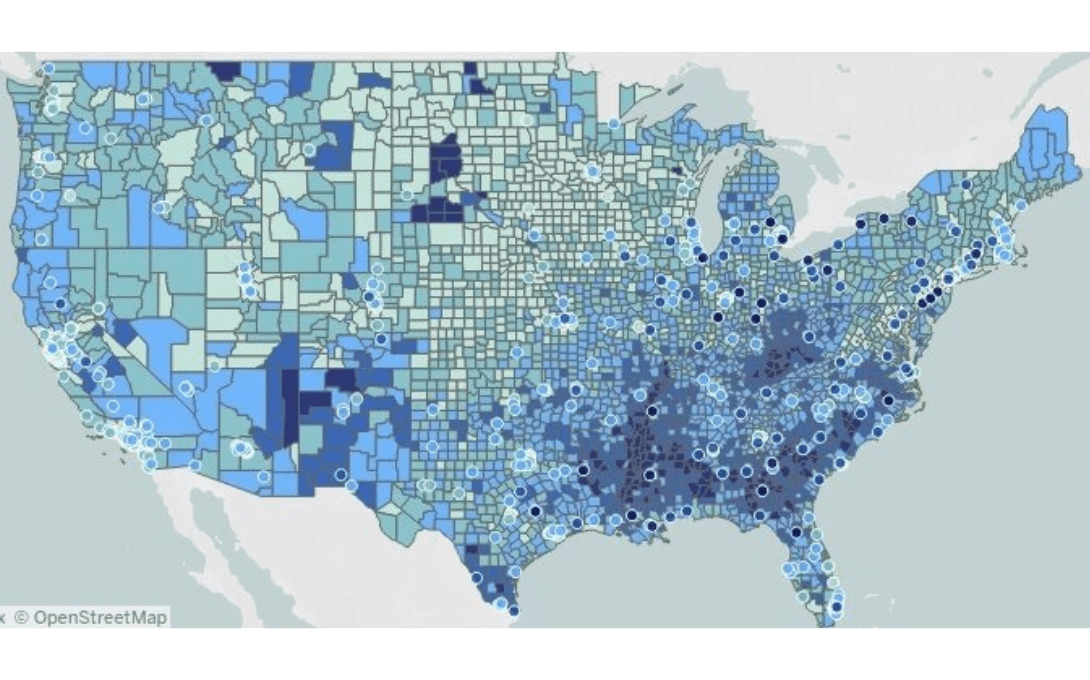
What does disadvantage look like in America? And where are the nation’s most disadvantaged communities?
With funding from the Robert Wood Johnson Foundation, a team of researchers from the University of Michigan and Princeton University – led by Kathryn J. Edin, H. Luke Shaefer and Timothy J. Nelson – explored this question and developed an Index of Deep Disadvantage to identify and better understand America’s most disadvantaged communities. They discovered that America's most disadvantaged communities are not the big cities that get the most notice. Instead, nearly all are rural.
This revelation set in motion a five-year journey across Appalachia, the Cotton and Tobacco Belts of the Deep South, and South Texas. Immersing themselves in these communities, pouring over centuries of local history, attending parades and festivals, the authors traced the legacies of the deepest poverty in America—including inequalities shaping people's health, livelihoods, and upward social mobility for families. Wrung dry by powerful forces and corrupt government officials, the "internal colonies" in these regions were exploited for their resources and then left to collapse.
The unfolding revelation in The Injustice of Place: Uncovering the Legacy of Poverty in America is not about what sets these places apart, but about what they have in common—a history of raw, intensive resource extraction and human exploitation. This history and its reverberations demand a reckoning and a commitment to wage a new War on Poverty, with the unrelenting focus on our nation's places of deepest need.
Index of Deep Disadvantage
To understand disadvantage across the U.S., researchers developed an Index of Deep Disadvantage using the same data for both counties and cities, which allows for direct comparison. This index represents a holistic look at disadvantage, using health indicators (life expectancy, low infant birth weight), poverty metrics (rates of poverty and deep poverty), and social mobility data (Opportunity Insights Mobility Metrics).
This measure of disadvantage is complemented by local perspectives that provide a deeper understanding of America's most vulnerable communities. By painting a vivid portrait of the conditions in the nation's most disadvantaged communities, the index not only uncovers what factors drive disparities, but it can help pinpoint where policymakers, state and local leaders, and residents can take action to improve health, well-being, and opportunity for all.
Suggested citation: Poverty Solutions at the University of Michigan and Princeton University. (2022). Index of Deep Disadvantage. https://poverty.umich.edu/research-funding-opportunities/data-tools/understanding-communities-of-deep-disadvantage/
News coverage of The Injustice of Place
What the Best Places in America Have in Common, The Atlantic
In the U.S., geography is fate. A new book on poverty seeks to change that, Los Angeles Times
Injustice of Place: Learning from history, State & Hill
Op-ed: Segregation academies show us the ugly side of vouchers, Daily Beast
Crystal City and the poverty of place, The Source / Texas Public Radio
How poverty in the U.S. is driven by the injustice of place, Spotlight on Poverty
How poverty is a direct result of corruption, Time
How studying place can provide insight on American poverty, Daily Yonder


