
Addressing the Links Between Poverty, Housing and Water Access and Affordability in Detroit
By Sara Hughes, Kathryn Maloney, Anna Kaczmarek, Heather Newberry, and Elizabeth Wallace
Download PDF of full policy brief
By Sara Hughes, Kathryn Maloney, Anna Kaczmarek, Heather Newberry, and Elizabeth Wallace
Introduction
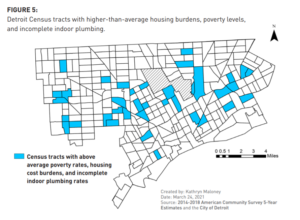
Ensuring water access and affordability for Detroit residents is critical. The COVID-19 pandemic has underscored the importance of universal access to safe and affordable water for public health, as well as the barriers and challenges to this goal created by conditions of high poverty and aging infrastructure. Solving the water access and affordability challenge in Detroit requires engaging with the interactive consequences of an aging system, high levels of poverty, and persistent housing challenges. Detroit’s median household income ($30,894) is just over half the statewide median ($57,144), and more than one-third of the city’s residents live below the poverty line. At the same time, 41% of the city’s residents face high housing costs, or housing costs that exceed 30% of household income. This number is even higher for renters, with 53% facing high housing costs. The majority of Detroit residents’ homes were built prior to 1950. Coupling an aging and insufficient housing stock with low incomes means residential plumbing issues may often go unaddressed, leading to higher water use and water bills, and eventually preventing access to drinking water all together. In 2018, an estimated 11,000 Detroit residents lacked access to complete indoor plumbing systems—meaning they lacked either hot and cold running water, a bathtub or shower, or a sink with a faucet. A recent study found water bills in Detroit are comparable to other large cities, but the burden is particularly high for Detroit residents due to low household incomes, with the city’s poverty rate sitting more than 2.5 times higher than the national rate. In 2016, 25% of residential water accounts were on a payment plan. Understanding the intersections of poverty, housing quality, and water services in Detroit is a step toward innovative and creative solutions that support public health and community resilience and promote efficiency in water use for the city’s water system as a whole. This brief evaluates the relationship between poverty, housing needs and burdens, and water access for Detroit residents, placing a particular focus on the need for and impact of plumbing repair efforts. We provide some background on water affordability in Detroit; analyze the impact low incomes, housing costs, and aging homes have on water access and affordability; and explore the potential of plumbing repairs as a cost-saving mechanism, including an analysis of the Water Residential Assistance Program (WRAP), the primary water assistance program serving Detroit residents. We find significant spatial variation in the location of households experiencing high housing costs and low incomes, which could inform future investment strategies for promoting water savings. Continued investment in residential plumbing repairs, and coordination across departments and between levels of government, will be critical for ensuring universal access to safe and affordable water in Detroit.Key Findings
- The intersection of poverty and housing quality presents a challenge for ensuring water access and affordability in Detroit.
- Existing plumbing repair supports in Detroit have benefits for residents’ water bills and water use.
- Increased funding for plumbing repairs, improved tracking and monitoring of performance outcomes, and coordination between city departments can support efficient and affordable water services in Detroit.
Policy Recommendations
While plumbing repairs will not solve Detroit’s water affordability crisis, they are an essential part of the solution. Below are some recommendations for how we can more effectively and efficiently deploy repair resources to generate savings for Detroit residents.- Expand Funding for Residential Plumbing Repairs
- As the federal government considers additional drinking water investments, resources should be available for conservation repairs as well as direct bill assistance.
- Michigan’s State Emergency Relief funding provides a one-time payment to households but is underutilized and insufficient. Increasing the resources available through SER, and revisiting how and when direct assistance is counted as income, can help to ensure that people who need access to resources can apply without penalty and help to broaden the program’s impact.
- The City of Detroit could explore alternative revenue sources, such as social impact bonds that tie investor returns to desired outcomes.