
Material Hardship and Mental Health Following the COVID-19 Relief Bill and American Rescue Plan Act
By Patrick Cooney and H. Luke Shaefer
Download PDF of the full policy brief
By Patrick Cooney and H. Luke Shaefer
Introduction
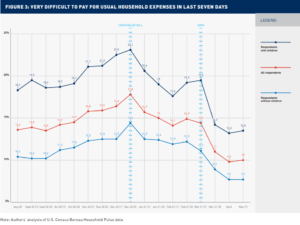
Throughout the COVID-19 pandemic, the U.S. Census Bureau has regularly deployed the Household Pulse Survey, which offers a real-time look at how U.S. households are dealing with the economic and public health crisis. Since summer 2020, researchers at Poverty Solutions have used Pulse data to measure the extent to which U.S. households are experiencing material hardship, such as insufficient access to food or inability to pay household expenses. Our analyses thus far have yielded a fairly simple story: throughout the crisis, the level of hardship faced by U.S. households can be directly linked to the federal government’s response. Despite historically high unemployment, in July 2020 we found that rates of hardship were stable—and in some cases declining—following the roll-out of Coronavirus Aid, Relief, and Economic Security (CARES) Act income support programs such as Economic Impact Payments (EIPs) and expanded unemployment insurance. Hardship remained relatively stable into early fall 2020 before increasing markedly in November and December 2020 as the economic recovery stalled and Congress delayed action on further relief measures. The trends we see in these hardship data are consistent with trends in other metrics of well-being during the crisis. This brief examines Household Pulse data for the early months of 2021 to understand the relationship between hardship and relief measures implemented following the passage of the COVID-19 relief bill in late December 2020 and the American Rescue Plan Act (ARPA) passed in early March 2021. We find that the delivery of robust, primarily cash-based assistance to U.S. households was followed by major declines in material hardship. Between December 2020 and late April 2021, rates of food insufficiency in the Pulse survey fell by over 40%, rates of financial instability fell by 45%, and the share of respondents reporting frequent symptoms of depression fell by 20%. The sharpest declines in hardship immediately followed the passage of these two relief bills, coinciding with the delivery of EIPs, and the gains were greatest among the lowest income households. All rates of hardship fell to their lowest levels recorded by Pulse following the passage of APRA. The economy improved some over the early months of 2021 and may have contributed to these trends, yet the unemployment rate remained above 6% in April. Rather, it would appear the circumstances of U.S. households improved following the delivery of robust income transfers deployed by the federal governmentKey Findings
- Material hardship in U.S. households fell sharply following the passage of the COVID-19 relief bill in late December 2020, and the American Rescue Plan Act (ARPA) in March 2021.
- From December 2020 to April 2021, food insufficiency fell by over 40%, financial instability fell by 45%, and reported adverse mental health symptoms fell by 20%.
- Declines in material hardship were greatest, in percentage point terms, among low-income households but also evident higher up the income distribution.
- Data from the past year suggest material hardship among U.S. households fell following implementation of robust federal income transfers, and rose in the absence of government action.
- We believe the success of the federal government’s relief measures may be due to the speed, breadth, and flexibility of its broad-based approach, primarily relying on cash transfers.