
Recognizing Trauma: Why school discipline reform needs to consider student homelessness
By Jennifer Erb-Downward and Michael Blakeslee
Download PDF of the full policy brief
By Jennifer Erb-Downward and Michael Blakeslee
Introduction
Michigan thrives when its children thrive. While policymakers, educators, and families all know this to be true, widespread use of suspension by the state’s public schools is leaving lasting scars on students. Compared to other states, Michigan schools have some of the highest suspension rates in the country. Two school districts rank among the top 10 nationally for suspensions among elementary schoolchildren and the state’s out-of-school suspension rate in school year 2015-16 was two percentage points higher than the national average (7% vs. 5%, respectively). Extensive research has linked both suspensions and expulsions to negative educational and life outcomes for children, including lower rates of proficiency on state math and English Language Arts examinations and increase in the risk of dropping out of school. Even 12 years later, suspended youth are less likely to earn a bachelor’s degree and are more likely to have been arrested or on probation than their peers who were not suspended. By comparison, research shows that positive school culture and the implementation of restorative justice and trauma-informed approaches reduce both in-school discipline referrals and out-of-school suspensions. In a study of 18 school districts across multiple geographies, districts that implemented restorative practice experienced an 8% decrease in middle school out-of-school suspensions, as well as a 43% drop in the number of Black youth referred to the juvenile justice system for school offenses. Similarly, research has highlighted the importance of school culture in efforts to reduce disciplinary actions. One key finding that repeatedly emerges in the research on how to improve school disciplinary practices is the importance of recognizing and understanding experiences of trauma in children. The fight-or-flight response, which can be easily triggered in children who have experienced trauma, is often misunderstood as a disciplinary issue. Approaching reactions driven by trauma in children with harsh disciplinary consequences does not improve the behavior in question and often re-traumatizes the child. One cause of trauma that is increasingly common among children is homelessness. In Michigan, roughly 1 in 10 students (9.5%) have experienced homelessness by the time they graduate or leave high school. This risk is even greater for Black and Hispanic students, with 15.7% and 13.6%, respectively, experiencing homelessness at some point during their K-12 years. Efforts to improve behavioral interventions in school are benefited by identifying the students who are most at risk of experiencing disciplinary actions. As the state looks to identify ways to reduce unnecessary disciplinary action and incorporate practices of restorative justice, it is important to understand factors that may contribute to inappropriate use of suspension and expulsion. One potential factor that has not yet been explored in Michigan is the relationship between experiencing homelessness and the likelihood of facing disciplinary action. This brief uses data from the Michigan Department of Education to explore suspension and expulsion rates among students who have experienced homelessness compared to their housed peers. The analysis finds both currently and formerly homeless students face much higher rates of disciplinary action. Policy recommendations for disciplinary practices that meet the developmental needs of children and teachers and promote thriving educational environments draw on models implemented in other states.Key Findings
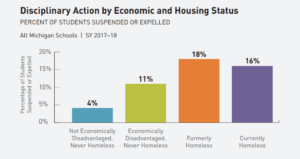
- Greater economic and housing instability is associated with higher rates of disciplinary action. Housed students who were economically disadvantaged were suspended at rates close to three times those of their housed peers who were not economically disadvantaged (11% vs. 4%, respectively). Homeless students faced even higher rates of disciplinary action at 16%.
- The association between homelessness and higher rates of disciplinary action persisted even after stable housing was found. Michigan students who were currently housed but had experienced homelessness at any point in the last eight years were disciplined at rates even higher than their currently homeless peers (18% vs. 16%, respectively).
- A strong intersection exists between race, economic security, and housing stability when it comes to disciplinary action rates for Michigan’s students. While across all races and ethnicities the same pattern persists, with formerly homeless students facing the highest rates of suspension and expulsion, Black students are disproportionately impacted. The U.S. has a long history of criminalizing Black people, and the pattern extends to the inequitable application of school discipline policies. Among students who were formerly homeless, Black students faced disciplinary action at close to four times the rate of their Asian formerly homeless peers (27% vs. 7%).
- Even very young elementary students who experienced homelessness faced high rates of suspension. In SY 2017-18, 9% of ever-homeless children in second grade and under were suspended or expelled. This disciplinary action rate is on par with high school students who had never experienced homelessness (8%).