
DETROIT—Detroit saw a 45% decrease in homicides and nonfatal shootings in a three-year period when the city launched its ShotStoppers program that equipped community-based groups to intervene and deescalate violent situations, according to a University of Michigan analysis.
Not to be confused with ShotSpotter—Detroit's gunshot detection system now known as SoundThinking—ShotStoppers is a community violence intervention program that empowers community members to disrupt violence in their neighborhoods, separate from law enforcement response.
ShotStoppers is one of many efforts—including Project Green Light and Ceasefire—the city of Detroit, Detroit Police Department and other groups have made in recent years to address gun violence in the city.
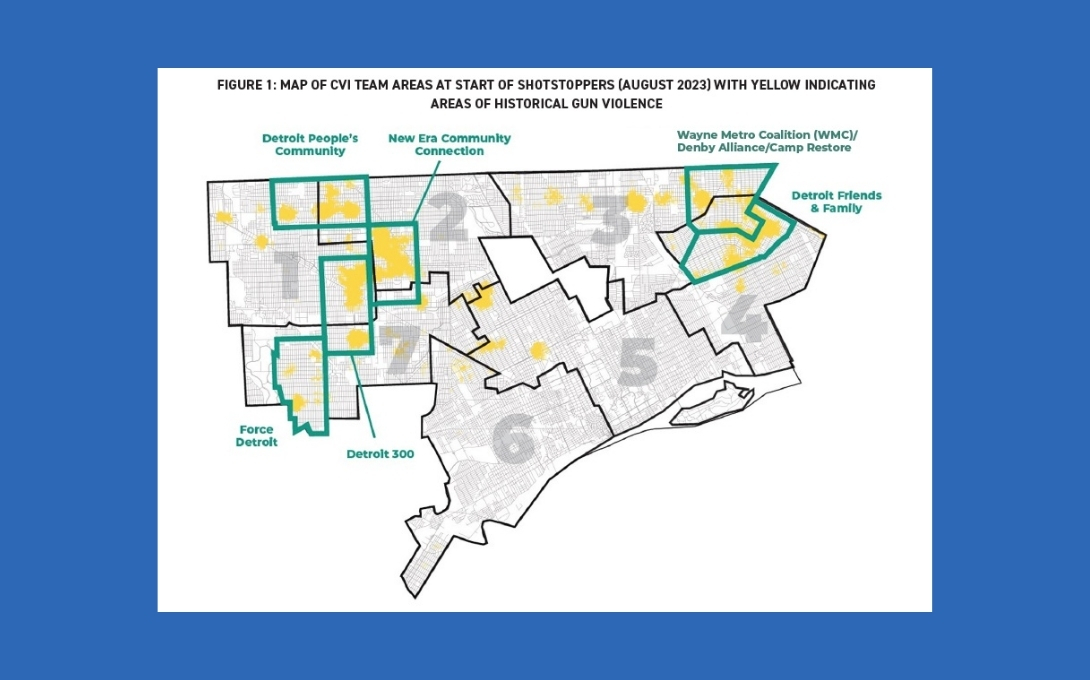
Launched in 2023, ShotStoppers funds selected community-based organizations, known as Community Violence Intervention teams, to develop and implement strategies to address violence in specific CVI zones, 3-to-5-square-mile areas of Detroit that have historically experienced high levels of gun violence.
A new evaluation of ShotStoppers by U-M's Poverty Solutions found that in the second year of the program, CVI zones saw a 33% decrease in homicide victims and a 38% decrease in nonfatal shooting victims from August 2024 to July 2025, compared to the previous 12 months.
In the rest of the city, homicide victims dropped by 12% and nonfatal shooting victims dropped by 26% over the same time frame. While the evaluation cannot show a definitive link between CVI programming and those reductions, the trend is promising.
"Addressing community violence is linked to expanding economic opportunity for Detroiters. Exposure to neighborhood violence adversely affects children's mental and physical health, educational performance and employment prospects, perpetuating the cycle of poverty," said Sam Stragand, senior program manager of Poverty Solutions' Detroit Partnership on Economic Mobility, who worked on the evaluation of ShotStoppers.
Through ShotStoppers, the city provides annual base funding—$175,000 per quarter—to each CVI team to support its efforts to reduce the number of homicides and nonfatal shootings in their respective designated zones. The current Detroit CVI teams are: Detroit 300, Detroit Friends & Family, Detroit People's Community, Force Detroit, Live in Peace, New Era Community Connection and Team Pursuit.
Teams can earn up to an additional $175,000 quarterly in performance-based bonuses for successfully reducing gun violence victims at a higher rate than the citywide average. City staff also coordinate shooting incident responses between the CVI teams and local police precincts. From 2023 to 2025, the city of Detroit invested $11 million of its American Rescue Plan Act funds in ShotStoppers.
"This study from the University of Michigan Poverty Solutions shows that Detroit's CVI program is contributing to historic reductions in violent crime and safer neighborhoods," said Detroit's CVI Program Director Michael Peterson. "Having trusted community organizations intervene in situations that could escalate into violence has proven remarkably effective in preventing potentially tragic outcomes."
In addition to analyzing shooting and crime data for 2021 to 2025, Poverty Solutions' evaluation of ShotStoppers included interviews and focus groups with CVI team members, police officers and city staff involved in the CVI program. The evaluation also draws from two representative surveys of Detroiters that asked about their perceptions of crime and safety in their neighborhoods.
The evaluation found CVI teams used two distinct strategies: 1) interventions with individuals and groups at high risk of involvement with gun violence, and 2) broader community engagement with resource provision.
CVI teams depended heavily on the trust and credibility they developed with individuals at high risk of gun violence and with their broader communities, the researchers found. Often, this trust was built on CVI teams employing local residents with lived experience with gun violence to lead the intervention efforts.
"Once you get one high-risk individual, it only takes one, then you are in the gang," one CVI team leader told the researchers. "Because barbers know barbers, nurses know nurses, educators know educators. They're in the same networks. So the goal is if you are able to leverage your relationship with the high-risk, they'll bring others along and refer you and they'll educate you about the others. And that's the whole point of why we were so big on that."
The evaluation noted the importance of the city's financial and administrative support for CVI teams, coupled with the teams having a high degree of autonomy to adapt their programming to the on-the-ground conditions of their neighborhoods.
After two years as a pilot program funded with one-time federal American Rescue Plan Act funding, ShotStoppers has become a city- and state-funded program embedded in the city government as part of the new Mayor's Office of Neighborhood and Community Safety.
The research team made the following recommendations for ways to build on ShotStoppers' initial success:
- Continue to institutionalize CVI within local government
- Refine performance metrics to incentivize CVI teams operating in zones where the number of homicide and nonfatal shooting victims are in the single digits
- Incentivize broader community engagement—beyond individuals at high risk of engaging in gun violence—to encourage more sustainable community support for CVI
"Our process is one of continual evaluation and improvement, and these recommendations are in complete alignment with our own internal assessments," Peterson said. "We already are looking at how to incorporate these changes into the program going forward."
The evaluation also identified opportunities to improve CVI teams' capacity to respond to domestic violence incidents and to work more closely with schools to intervene with students at risk of perpetuating gun violence.
"Nationwide, we're seeing more local governments get involved with Community Violence Intervention programs. Detroit's model shows promise, and additional evaluation of ShotStoppers as it continues to evolve can point to ways for local officials and other cities to build on this success," Stragand said.