
Stopping the Eviction Machine in Detroit
By Patrick Cooney and Amanda Nothaft
Download PDF of the full policy brief
See an article on the Eviction Machine research
By Patrick Cooney and Amanda Nothaft
 Download PDF of the full policy brief
Executive Summary
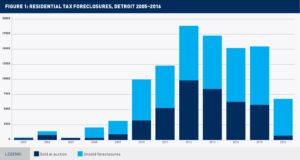
From 2005 to 2015, 120,000 residential properties in Detroit—nearly half of all residential properties in the city—experienced mortgage or tax foreclosure. A substantial number of these properties were sold to speculative investors who purchased properties in bulk, either through mortgage or tax foreclosure markets, while tens of thousands of tax foreclosed homes went unsold. This brief summarizes “The Eviction Machine: Neighborhood Instability and Blight in Detroit’s Neighborhoods,” by Joshua Akers and Eric Seymour, which details the ways in which speculators or bulk buyers have operated in the city of Detroit over the past decade, and how the practices they employ generate housing and neighborhood instability. Akers and Seymour find that thousands of properties purchased by bulk buyers out of foreclosure markets have been the site of multiple evictions, neglect, additional tax foreclosures, and eventual demolition at public cost. Key findings include:- 90% of all purchases from the Wayne County tax foreclosure auction have been to investors and bulk buyers since the tax foreclosure auction began in 2002.
- There is a subset of bulk buyers who use eviction as part of their business model, filing hundreds of evictions for the properties they own.
- Since 2014, it has cost an estimated $34 million in public funds to demolish blighted homes purchased by speculators out of the tax foreclosure auction.
Download PDF of the full policy brief