Our Work in Action
Our annual impact reports demonstrate how Poverty Solutions has worked with partners to inform concrete policy change in the areas of cash assistance, youth homelessness, financial well-being, and more.
The University of Michigan has a proud tradition of groundbreaking research and teaching on poverty and inequality. U-M scholars have made pivotal contributions to knowledge and policymaking in the field of poverty dating back to the 1950s. Established in 2016, Poverty Solutions builds on this tradition.
[Luke Shaefer] Poverty Solutions is a university-wide initiative. Our charge is to partner with communities and policymakers to find new ways to prevent and alleviate poverty. It really builds on a rich, long tradition of research on poverty and inequality at the University of Michigan.
But it tries to take it to the next level of saying, let’s build on basic research that tells us about the causes and consequences of poverty to really get out into communities and, in a rigorous way, bring evidence to bear on ways to make systems work better. We really think about poverty as a result of a set of interlinked systems—education, criminal justice, employment, health care—that don’t quite function like they should for families at the very bottom of the economic ladder. So we want to work with communities, and we want to work with policymakers, to try to make those systems work better.
To really look for concrete ways to intervene such to empower families to live healthy and productive lives. So one of the key sort of drivers of our work is not going into partnerships with policymakers or communities thinking that we remotely have all of the answers, but to really start with listening. To really go in and say, what are the greatest challenges that you face, and what are the assets?
And how can we be a partner in bringing data, research, and evidence to bear in finding concrete ways to build new solutions and to test them out and then to evaluate to see if they work in the way that we all intended. The thing we care most about is how things that have changed in the world that we think will empower families to live healthy and productive lives.
Poverty Solutions is a university-wide initiative on a mission to partner with communities and policymakers to find new ways to prevent and alleviate poverty through action-based research. We aim for this action-based research to inform policy change that make systems work better for people with low incomes.
We view poverty as the result of interlinked systems — housing, education, criminal justice, labor markets — that do not work for people with low incomes. Such a systems approach puts the emphasis on structural, rather than individual, causes of poverty.
We recognize that many of these systems failures are the result of long-term racial and socioeconomic inequalities. Addressing poverty means confronting these disparities and seeking out just, equitable solutions.
By focusing on systems, we seek to partner in action that positively impacts the lives of many families. We look for ways to intervene through action ranging from small scale, community-focused projects to large-scale policy change.
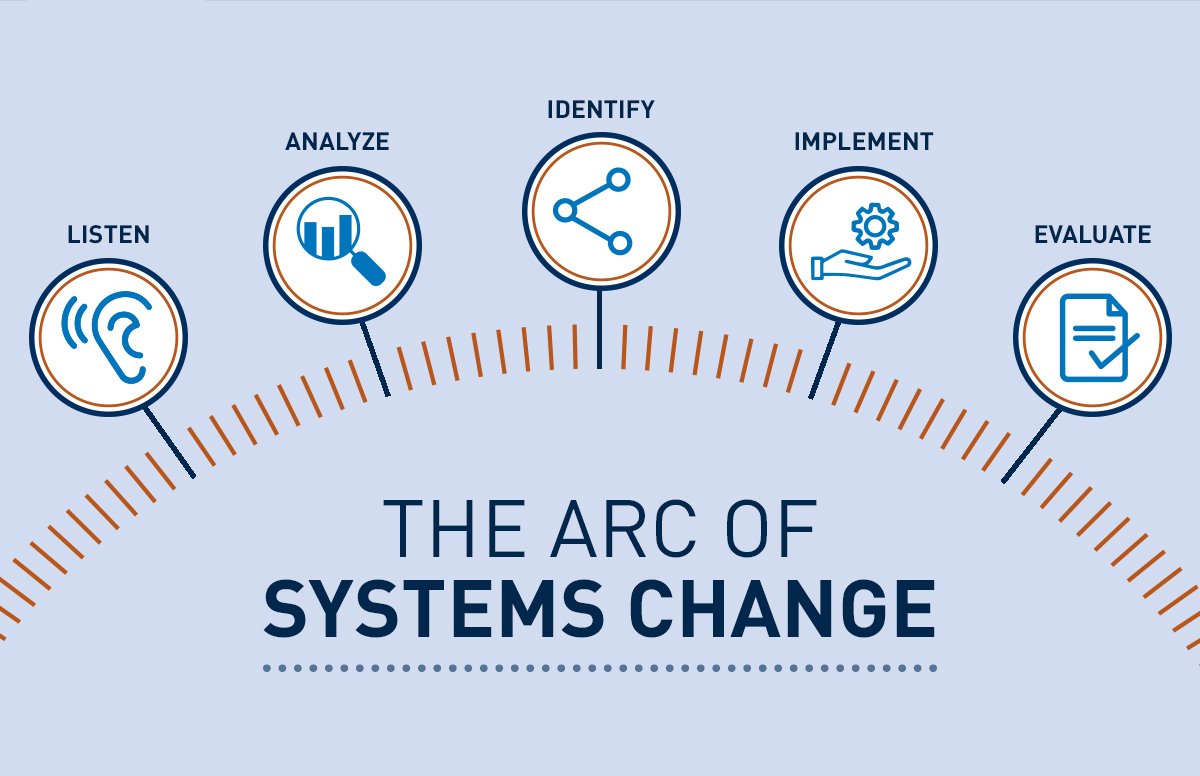
We conceptualize our work as an arc of change. We start with listening to community input to set a collective research agenda and then analyze data and research to help identify policy gaps. Next, we identify possible solutions and propose evidence-based interventions. Finally, we support the implementation of new policies and practices and evaluate the outcome — listening again as new models take shape.
Our ability to collectively fulfill the mission and values of Poverty Solutions begins with our culture. Here, we believe: everyone deserves to be treated with respect, trust is built, and collaboration leads to a stronger team and stronger outcomes. To foster this culture, we practice respect, trust-building and collaboration by committing to:
How we engage with each other impacts how we engage in partnerships inside and outside the university and in the mentoring of students. By committing to our vision for our internal workplace culture, we are better able to live out our organizational values, resulting in work that has a more widespread, relevant, and meaningful impact on preventing and alleviating poverty.
Poverty Solutions exemplifies the meaningful positive impact that’s possible when scholars take an interdisciplinary approach to tackling society’s most pressing issues and leverage university resources to work alongside community groups, policymakers, and other stakeholders.
Our annual impact reports demonstrate how Poverty Solutions has worked with partners to inform concrete policy change in the areas of cash assistance, youth homelessness, financial well-being, and more.