
History
To know where we’re going we have to know where we’ve been. The University of Michigan has a proud tradition of poverty research and teaching, dating back to the 1960s.
Past efforts have trained leading poverty scholars who have gone on to make pivotal contributions to programs and policy from the local to national levels. This rich history is woven into the fabric of Poverty Solutions at U-M, and will inform our future endeavors.
1964
- In 1964, the U.S. was about two decades out of the Great Depression, the national poverty rate hovered around 19 percent, and President Lyndon Johnson was seeking ideas for a radical domestic program to inspire American voters — many of whom were still grieving the death of John F. Kennedy.
- At U-M’s Spring Commencement that year, President Johnson — the first sitting president to address commencement at the university — outlined a loose plan to declare “war” on poverty and create a “Great Society.” He was elected in a landslide that fall and set about making good on his promise.
- Congress responded by forming the Office of Economic Opportunity, developing policies designed to help the nation’s poor.
1968
- In 1966 and 1967, in an effort to track whether its programs actually worked, the government targeted some 30,000 American households and embarked on interviews. Understanding the value of continuing to track people in poverty, the government researchers approached Jim Morgan, an economist with the U-M Institute for Social Research (ISR). This eventually led to the Panel Study of Income Dynamics (PSID), the longest-running and most complete portrait of the economics of the American family.
1968
- As the 7th United States Secretary of Health, Education and Welfare, Wilbur J. Cohen was instrumental in developing both the New Deal and Great Society programs during the Johnson Administration. In December 1968, he wrote A Ten-Point Program to Abolish Poverty that future leaders used a blueprint for later legislation.
- After successfully helping to create the Social Security System, he came to U-M as a professor of social work. Wilbur returned to the university as Dean of the School of Education after his service in the Kennedy and Johnson administrations.
https://www.lib.umich.edu/faculty-history/faculty/wilbur-j-cohen
https://www.ssa.gov/policy/docs/ssb/v31n12/v31n12p3.pdf
1971
- A pioneer in interdisciplinary study, Max Heirich taught one of the university’s first courses specifically focused on poverty. The 1971 course, Perspectives on Poverty, used a “variety of methods to explore the phenomenon of poverty in an affluent society.”
1989 – 2015
- Sheldon H. Danziger launches the Research and Training Program in Poverty and Public Policy, which is the foundation for U-M’s National Poverty Center. The program provided mentorship and support for over 50 postdoctoral fellows and doctoral students on the causes and consequences of urban poverty.
1995 – 2002
- The National Institute of Mental Health, the Center on Poverty, Risk, and Mental Health operated for seven years expanding knowledge for research and practice on the relationship between poverty and mental health. The Center’s mission was to facilitate scholarship concerning the linkages between poverty and mental health; to develop a core faculty of social work researchers in this area; and to contribute to knowledge relevant for practice and policy.
1997
- The Women’s Employment Study combines the insights of poverty researchers, epidemiologists, and social workers by analyzing the ways in which a broad range of labor market, mental health, physical health, and family problems affect a welfare recipient’s ability to obtain and retain employment overtime.
- Led by the National Poverty Center, the study examined women who resided in one urban county and received cash welfare in February 1997 through the Temporary Assistance for Needy Families (TANF) program.
- The study resulted in dozens of widely-cited journal articles, dissertation chapters and books. And results were replicated by other welfare policy researchers and influenced policy thinking about welfare mothers whose health and mental health problems kept them from working even when the unemployment rate was low.
2002 – 2016
- The National Poverty Center (NPC) at U-M’s Gerald R. Ford School of Public Policy was established in the fall of 2002 as a university-based, nonpartisan research center. NPC conducted and promoted multidisciplinary, policy-relevant research, mentored and trained emerging scholars, and informed public discourse on the causes and consequences of poverty.
- The NPC encouraged and enabled younger scholars to develop interests, skills, and expertise in poverty research, many of whom have gone on to leadership positions across the country.
- Sheldon Danziger, currently the President of the Russell Sage Foundation led the evolution of the National Poverty Center as the Henry J. Meyer Distinguished University Professor of Public Policy at the Gerald R. Ford School of Public Policy, Research Professor at the Population Studies Center, and Director of the National Poverty Center at the University of Michigan.
2007 – 2009
- Supported by the Rackham Graduate School, the Interdisciplinary Group on Poverty and Inequality provided a forum for graduate and professional students from all disciplines to discuss literature and to present original research on issues of poverty, inequality and disparity.
2011
- Led by the School of Social Work, Learning Community on Poverty & Inequality promotes opportunities to link the research, policy and service, and teaching interests of faculty for whom poverty and inequality are some of the compelling core roots of their scholarship.
- Michigan Recession and Recovery Study (MRRS) panel study to better understand how the Great Recession that officially lasted from December 2007 through January 2009, and the collapse of stock and housing prices during this period have affected the wellbeing of workers and families.
2016
On October 5, 2016, the University of Michigan launches Poverty Solutions, a university wide effort to explore and test models to ease the effects of poverty and broadly share that knowledge, while working with community groups and supporting active-learning options for students.
October 2016
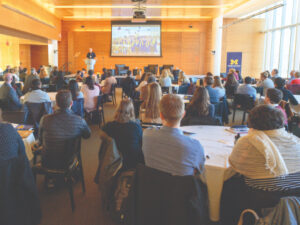
- Poverty Solutions (PS) is launched and then-Associate Professor H. Luke Shaefer is named inaugural director. Julia Weinert, who is still Poverty Solutions managing director today, was one of two initial staff members who joined Shaefer in establishing the presidential initiative, which is housed at the Gerald R. Ford School of Public Policy and builds on the work of the National Poverty Center previously located at U-M.
- PS provides support for a representative survey of Detroiters launched by the Detroit Metro Area Communities Study. It builds on the 53-year legacy of the Detroit Area Study, a hands-on training tool for U-M students from 1951 to 2004.
2017
January 2017
- First recipients of faculty grants and community-academic grants supported by Poverty Solutions (PS) and Detroit Urban Research Center.
February 2017
- PS faculty affiliate David Johnson, director of the U-M Panel Study on Income Dynamics at the Institute of Social Research, delivers a statement on the Supplemental Poverty Measure to the Congressional Commission on Evidence-Based Policymaking.
June 2017
 PS becomes a partner in Washtenaw County’s Summer Youth Employment Program (later SummerWorks), which provides internships and professional development opportunities for teens and young adults in Washtenaw County.
- PS Director Luke Shaefer and faculty affiliates Michael Barr, incoming dean of the Ford School; Trina Shanks, social work professor; and Bruce Pietrykowski, economics professor, among others, contribute to a discussion on the future of work, wages, and labor hosted by U.S. Congresswoman Debbie Dingell (MI-12) and her colleagues.
- PS hosts public engagement events on upward mobility in Detroit, making housing more affordable, addressing early-in-life disparities, youth employment programs, the possibility of the U.S. enacting a universal child allowance, and more.
- U-M’s Institute for Healthcare Policy and Innovation, the Detroit Health Department, and the Joy-Southfield Community Development Corporation, Inc. develop an innovative model for a Community Health Worker-led demonstration project in the Cody Rouge neighborhood, with three Medicaid health planners working in conjunction with neighborhood residents receiving professional development training. Supported by a community-academic grant from PS.
September 2017
- PS supports a $2 million Urban Collaboratory funded by U-M that brings together faculty experts in smart city technologies and urban design to collaborate with city leaders and residents in Benton Harbor, Detroit, Grand Rapids, Ypsilanti, and Ann Arbor.
December 2017
- PS partners with Munger Graduate Residences on its annual case competition to challenge students to consider how they would spend fictional seed money of $100,000 to address the root causes of poverty.
- PS launches its Michigan Poverty & Well-being Map to help policymakers, community organizations, and the public understand poverty in their communities. The map is updated annually.
2018
January 2018
- Susan Dynarski, a former U-M professor and Poverty Solutions (PS) faculty affiliate, testifies before the U.S. Senate Committee on Health, Education, Labor and Pensions, at a hearing titled “Reauthorizing the Higher Education Act: Financial Aid Simplification and Transparency,” discussing what lessons Congress can draw from loan repayment models in other countries.
- PS and the School of Social Work’s Community Action and Social Change minor partner to bring undergraduate students a PS certificate program.
- Announcement of recipients of second round of faculty grants and community-academic grants in partnership with Detroit Urban Research Center.
March 2018
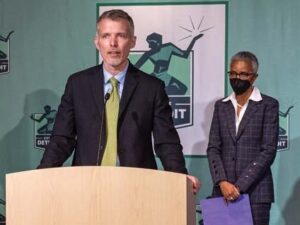 PS launches 4-year agreement with the City of Detroit’s Mayor’s Office to support the Detroit Partnership on Economic Mobility, which includes a fellows program. The partnership, spearheaded by PS Assistant Director of Policy Impact Patrick Cooney, focuses on housing, workforce development, health and well-being, and education.
- PS partners with U-M’s Urban Collaboratory to study how and where improvements to public transportation in Benton Harbor could help alleviate poverty in the city.
- PS joins 313Reads and Munger Leads When Munger Reads early literacy efforts in Detroit, offering data analysis and evaluation support.
April 2018
- Analysis by PS reveals students who have experienced homelessness have lower graduation rates and higher dropout rates than their housed peers. PS research on student homelessness will go on to inform changes to practices by school homeless liaisons and Detroit’s homeless shelter system.
- In response to preliminary findings from a 2017 community-academic research project on barriers to accessing the Poverty Tax Exemption in Detroit, PS partners with the U-M School of Public Health, Detroit Urban Research Center, and United Community Housing Coalition to develop a campaign to raise awareness of the tax exemption.
- The Detroit Metro Area Communities Study receives $761,000 from the Knight Foundation to expand its representative survey of Detroit residents.
May 2018
- Ashleigh Johnson, former community engagement coordinator at PS, convenes nonprofit agencies, foundations, and others from Wayne, Oakland, and Macomb counties to share new research, best practices, and innovative programs, and identify mutually beneficial opportunities for collaboration and coordination.
June 2018
- Karen Otzen Kling is hired as the City of Detroit’s affordable housing fellow, supported by PS’ Detroit Partnership on Economic Mobility. Kling’s work led to recommendations on ways to serve more people with available home repair funds. She later joined the PS staff as senior strategic projects manager.
- PS builds relationships in Lake County to learn more about how poverty affects the community, and share resources and data to support the work of local community leaders.
- PS shares findings from a 2017 faculty research project led by Lesli Hoey, of U-M’s Taubman College of Architecture and Urban Planning, demonstrating that new work requirements for food assistance in Michigan adversely impact families in Washtenaw County, and increase the burden placed on community groups that provide food and housing assistance.
September 2018
- U-M, Harvard partner on Equality of Opportunity project in Detroit.
- The inaugural Real-World Perspectives on Poverty Solutions speaker series brings to campus a diverse group of experts drawn from university, business, and community contexts to explore interdisciplinary real-world poverty solutions from a wide variety of perspectives. The annual fall speaker series, coordinated by PS Student Engagement and Strategic Projects Manager Trevor Bechtel, is open to the public and serves as a one-credit course for students.
- PS partners with Food Finders, a nonprofit started by then-UM student Jack Griffin, to build a database of free food sources across the country.
- Older Black Americans are three times more likely to experience homelessness: A study co-authored by Boston College Professor Vincent A. Fusaro; Helen Levy, a research professor and PS faculty affiliate; and PS Director Luke Shaefer is published in Demography.
 PS hosts public engagement events on innovative programs for youth and young adults, transportation and economic mobility, how social services can reduce housing instability, and basic income as a poverty alleviation strategy.
- K-12 students in Michigan are among the nation’s most chronically absent, and homeless students are at particular risk, according to a new analysis from Jennifer Erb-Downward, senior research associate at PS.
- Better implementation of state law could improve housing stability for Detroit homeowners: PS shares findings from research on access to the Poverty Tax Exemption in Detroit led by Alexa Eisenberg, who is now a postdoctoral research fellow with PS; and Roshanak Mehdipanah, PS faculty affiliate in the School of Public Health; in partnership with United Community Housing Coalition.
- PS begins working with Washtenaw County’s Office of Community and Economic Development to update its Opportunity Index, which maps a variety of metrics related to access to opportunity by census tract. Working closely with county officials, PS helps with revising metrics, revamping methodology, data analysis, and developing a narrative to help users make sense of the disparities revealed by the index.
2019
January 2019
- Announcement of third round of faculty grants and community-academic grants supported by Poverty Solutions (PS) and Detroit Urban Research Center.
February 2019
 Joshua Edmonds is hired as the City of Detroit’s digital inclusion fellow, supported by PS’ Detroit Partnership on Economic Mobility. He is also named the city’s director of digital inclusion, a position he still holds. Edmonds laid the groundwork that led to a more than $27 million investment to narrow the digital divide during the pandemic in 2020.
March 2019
- Laura Urteaga-Fuentes is hired as the City of Detroit’s homelessness policy fellow, supported by PS’ Detroit Partnership on Economic Mobility. She developed clear policy and procedures for addressing homeless encampments in the city. Urteaga-Fuentes went on to become the program manager for workforce and homeless system alignment at Detroit Employment Solutions Corporation.
- PS hosts an engagement series titled “Workforce: Solving for Jobs, Mobility, and Poverty in an Era of Rapid Change.”
May 2019
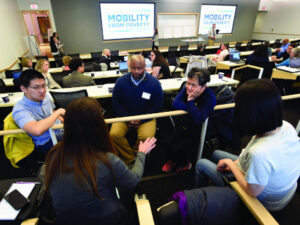
- PS convenes the Midwest Mobility from Poverty Network, which connects university-based poverty research centers in the Midwest to share best practices and strategies to maximize impact.
- Former PS staffer Joshua Rivera, now the Economic Stability Administration policy director at the Michigan Department of Health and Human Services, testifies before the U.S. House Financial Services Committee’s Oversight and Investigations Subcommittee to share findings from his analysis of the factors driving Michigan’s highest-in-the-country auto insurance rates. Gov. Gretchen Whitmer cited PS research when calling for auto insurance reform in 2019; in May, she signed a bipartisan auto insurance reform bill that included policy recommendations from PS.
- Michigan counties struggle to meet the need for opioid addiction treatment: PS shares findings from an analysis of drug treatment needs across the state, led by Amy Bohnert, associate professor at U-M’s Department of Psychiatry, with Jennifer Erb-Downward of PS and Thomas Ivacko, executive director of the Center for Local, State, and Urban Policy at U-M.
June 2019
- Earned Income Tax Credit helps low-income moms live on their own: PS shares findings from research supported by a 2017 faculty grant and led by Natasha Pilkauskas, assistant professor of public policy at U-M.
- New report finds childhood homelessness is rising, much higher than state data show: PS partners with the Michigan League for Public Policy to analyze data and explore rates of homelessness among youth between birth and age 4.
August 2019
- Kristin Seefeldt, an associate professor of social work and public policy, joins PS as the new associate faculty director for educational programs.
September 2019
- PS publishes the Detroit Home Repair Resource Guide to help increase Detroiters’ access to available home repair programs. The guide was a response to an information gap identified through research on home repair needs in Detroit.
- Speakers involved in the Real-World Perspectives on Poverty Solutions fall series answer the question, “What does poverty mean to you?”
November 2019
- Wealth begets educational disparity: The Journal of Youth and Adolescence publishes findings from research supported by a 2018 faculty grant from PS. Led by Matthew Diemer, associate professor of educational studies, the study followed children over a 27-year period to shed light on how wealth influences learning outcomes.
- Luke Shaefer is named special counselor to the director of Michigan Department of Health and Human Services. The position builds on efforts to advise MDHHS on a set of poverty-related programs and policy recommendations PS undertook over the summer. Amanda Nothaft, senior data and evaluation manager at PS, provides data analysis for MDHHS, and her evaluation of asset limit policies led to policy changes implemented Dec. 1, 2019, that simplified and streamlined access to critical benefits.
December 2019
- Detroit’s Eviction Machine: City of Detroit reviews link between tax auction, housing instability in response to PS study led by Joshua Akers, assistant professor of geography and urban and regional studies at UM-Dearborn.
2020
January 2020
 Announcement of third round of community-academic grants in partnership with Detroit Urban Research Center.
- Poverty Solutions (PS) fellow Joshua Edmonds testifies before Congressional subcommittee on digital equity and internet adoption.
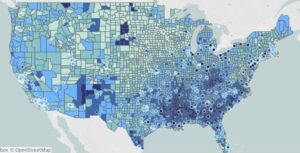
- New index ranks America’s 100 most disadvantaged communities: PS and Princeton University release findings from “Understanding Communities of Deep Disadvantage,” a research project begun in 2018 that includes the development of a new multidimensional index measuring disadvantage and exploration of the historical and present-day factors that drive deep disadvantage in certain regions.
- Chardae Caine is hired as the youth workforce development fellow for the City of Detroit, supported by PS’ Detroit Partnership for Economic Mobility. She provides the city and its stakeholders with research and support to develop and implement a comprehensive youth opportunity strategy.
March 2020
- The United States declares a state of emergency related to COVID-19. The spread of the virus and economic shutdown highlight underlying inequities in health care systems and employment. PS leans into its mission, documenting how the pandemic is impacting people with low incomes and pointing to evidence-based government interventions and policy responses that would make a difference.
- Luke Shaefer appointed as the Ford School’s inaugural Kohn Professor of Social Justice and Social Policy.
- PS releases Michigan COVID-19 Pandemic Resource Guide. More than 7,100 people viewed the guide and service providers shared the information in their own resource guides.
April 2020
- As the first round of stimulus checks went out, PS analysis revealed people in deep poverty were at risk of a delayed or missing stimulus payment. PS worked with nonprofit design firm Civilla to create a website with clear guidance on how to access the stimulus checks, especially for people who do not typically file taxes because they have no income, do not have a bank account, or move frequently. PS went on to update the website with information on each round of stimulus checks; the site has garnered nearly 590,000 views.
- The Detroit Metro Area Communities Study (DMACS) finds 1 in 5 Detroiters will be out of money in 3 months due to COVID-19 crisis. DMACS Project Lead Sharon Sand and her team field a series of rapid-response surveys to provide timely insights into how COVID-19 and the related economic downturn affect Detroiters.
May 2020
 Detroit housing shortage, evictions set stage for COVID-19 housing crisis: A policy brief from PS provides analysis of Detroit’s current housing stock and makes recommendations to reduce evictions once the emergency moratoriums end.
- A study supported by a 2019 PS community-academic grant offers the first comprehensive review of eviction filings across Michigan. The Michigan Eviction Project, led by Robert Goodspeed, associate professor of urban and regional planning at U-M, in partnership with Legal Services of South Central Michigan, informed PS’ contributions to a working group with the governor’s office to establish a comprehensive $50 million eviction diversion program.
June 2020
- Coronavirus pandemic worsens food insecurity for low-income adults: Julia Wolfson and Cindy Leung of the U-M School of Public Health share findings from their study of household food security, supported by a 2020 PS faculty grant.
- PS hosts “The Poverty Narrative: A Midwest Perspective” virtual series. Spearheaded by former PS Communications Director Kristen Kerecman and Senior Communications Specialist Lauren Slagter, the series brought together journalists and academic researchers from across the Midwest to discuss ways to promote more in-depth, impactful, and solutions-oriented coverage of poverty-related issues.
- A new report from DMACS, Detroit Future City, and the New Economy Initiative reveals Detroiters’ perceptions of entrepreneurship and economic opportunity.
July 2020
- PS publishes the first of a series of policy briefs tracking material hardship levels during the pandemic and the impact of income support in the form of stimulus checks and expanded unemployment insurance.
- The Midwest Mobility from Poverty Network, led by Poverty Solutions, awards six grants totaling $150,000 for projects to improve economic mobility and address the impact of COVID-19 throughout the Midwest.
August 2020
- Shaefer testifies at a virtual Congressional briefing to discuss opportunities to enhance the Earned Income Tax Credit and Child Tax Credit.
- PS publishes an analysis of the extent to which jobs available in Detroit and the tri-county area match the skills and attributes of Detroit residents. This work — led by former PS staffers Pinghui Wu and Joshua Rivera with Samiul Jubaed, PS data and policy analyst — builds on previous evaluation of barriers to work among Detroiters and the potential for a publicly subsidized employment initiative to address those barriers.
- The American Enterprise Institute publishes new research by Shaefer and Rivera that examines Employer Resource Networks, an innovative model where local networks of employers collectively provide work support services to their entry-level workforces, with the goal of enhancing productivity and retention.
September 2020
- A new report from PS titled “Investing in Us” lifts up more than a decade’s worth of input from Detroit residents on how to increase economic mobility and decrease poverty in their city. Afton Branche-Wilson, assistant director of community initiatives at PS, led the research team that included leaders from 10 nonprofits.
October 2020
- PS and Center for Social Solutions partner to award more than $260,000 for research on combating racism. PS Administrative Coordinator Armeka Richey facilitates the grant process and contributes to a committee that reviews the initiative’s other grant programs and recommends ways to ensure the poverty-alleviation research also addresses structural racism.
- Student research assistants help develop a new #BankBlack interactive map that makes it easier for people to identify Black-owned banks and credit unions across the country in an effort to leverage Black economic power and overcome the racial wealth gap. This partnership between BankBlackUSA and U-M students continues in the coming years.
- PS is one of 3 organizations across the country contributing to a new “Education Leads Home” Data-to-Action Playbook that will offer guidance on how to use student homelessness data to advocate for better support for youth without a stable place to live.
December 2020
 After pivoting to virtual programming and launching a mentorship program in 2020, SummerWorks staff — led by SummerWorks and Strategic Projects Manager Zoe Erb — create a mentoring guide to share lessons learned and help individuals and organizations foster productive professional relationships with young adults.
2021
January 2021
- Washtenaw County Prosecutor Eli Savit launches the Prosecutor Transparency Project in partnership with the ACLU of Michigan, the University of Michigan Law School, and Poverty Solutions (PS) to uncover potential racial inequities through the collection and analysis of data regarding decisions made by the prosecutor’s offices in Washtenaw, Oakland, and Ingham counties.
- The Andrew W. Mellon Foundation’s Just Futures Initiative grant competition awards two $5 million grants to U-M. The “Crafting Democratic Futures” project will explore community-based reparations solutions for African American and some Native American communities, led by U-M’s Center for Social Solutions with support from PS, University Musical Society, and other U-M units.
- PS releases a report by Afton Branche-Wilson and Patrick Cooney on the financial well-being of Detroit residents. United Way for Southeastern Michigan goes on to develop a $2 million, multi-year innovation challenge that will provide support for organizations working to address the barriers to financial well-being identified by PS research.
February 2021
- New research supported by PS and led by Postdoctoral Fellow Alexa Eisenberg shows a $1 million home repair grant program in Detroit has helped homeowners with low incomes complete major home repair projects that improve the quality and safety of their housing and increase their chances of remaining in their homes long term.
March 2021
- DMACS continues to field rapid-response surveys that show how the pandemic impacts Detroiters and how their perceptions of the COVID-19 vaccine and experiences with unemployment have changed over time. A later wave of the survey asks about perceptions of policing and crime.
- PS hosts its second Poverty Narrative virtual event series, dedicated to a deeper understanding of the connections between structural racism and poverty.
April 2021
- Washtenaw County launches its new Opportunity Index, developed in partnership with PS. Spearheaded by Data and Evaluation Manager Natalie Peterson, the index maps key data points across five categories — health, job access, economic well-being, education and training, and community engagement and stability — to measure how the location of people’s homes in Washtenaw County impacts their access to opportunity.
- PS launches its redesigned website that makes it easier for people to get involved with the initiative, explore research by key issue area, and follow the latest news. Web Developer Liz Smith is key to implementing the redesign.
- A new website from PS offers step-by-step guidance for parents to ensure they receive the expanded Child Tax Credit. The website had more than 13,000 views by the end of 2021, and PS would go on to join a Detroit coalition coordinating outreach efforts to ensure eligible parents claim the tax credit. Luke Shaefer is among a group of poverty scholars who have contributed significant research on the potential for an expanded child tax credit that follows the design of a child allowance to reduce child poverty rates in the U.S.
May 2021
- New research supported by Poverty Solutions’ Confronting and Combating Racism grant program offers insights into the location, nature, and perpetrators of anti-Asian hate incidents that occurred in the U.S. during the COVID-19 pandemic. The Virulent Hate Project is led by Melissa Borja, assistant professor in U-M’s Asian/Pacific Islander American Studies Program.
- Jennifer Erb-Downward testifies before the U.S. House Subcommittee on Early Childhood, Elementary, and Secondary Education about her research on the educational challenges faced by students who do not have a stable place to live.
June 2021
- The Michigan Eviction Project, led by U-M faculty and housing attorneys with support from PS, finds the number of eviction cases filed between April and December 2020 represented a 65% decrease from the number of cases filed during those months in 2019. Their new report offers insights into how Michigan can maintain the low eviction rates achieved during the COVID-19 pandemic.
- PS’ latest analysis of material hardship levels during the pandemic and the impact of the federal government’s response is the focus of a New York Times article and goes on to be cited by dozens of news outlets across the country as well as the White House Press Office.
- PS announces a grant opportunity to support Detroit organizations running economic mobility programs that implement recommendations made in the 2020 report, “Investing in Us: Resident Priorities for Economic Mobility in Detroit.” Church of Messiah Housing Corporation, Journey to Healing, Urban Neighborhood Initiatives, and Wayne Metropolitan Community Action Agency are later announced as recipients of the $10,000 grants plus technical assistance from PS.
July 2021
- An expert in survey research and public opinion analysis, Mara Cecilia Ostfeld joins PS as associate faculty director of communications. She is also a faculty lead at DMACS and an assistant research scientist at the Ford School.
- PS hosts a Detroit working group to hear about residents’ experiences with land contracts as part of a Community Experts Initiative that convenes community leaders with lived and experience confronting poverty to share insights and resources to help generate new ideas for action. PS’ Karen Kling and Leonymae Aumentado presented findings from a policy brief they co-authored with Enterprise Community Partners on ways to better regulate land contracts.
- In a study supported by a 2020 faculty grant from PS, researchers find 10% of Detroit’s population lives in “triple burdened” census tracts with higher than average rates of poverty, housing cost burden, and incomplete plumbing. The research was led by Sara Hughes, an environmental policy analyst at U-M’s School for Environment and Sustainability.
Summer 2021
- Karolina Ramos is hired as the City of Detroit workforce development fellow, supported by Poverty Solutions’ Detroit Partnership on Economic Mobility. She supported the city’s implementation of the American Rescue Plan Act.
August 2021
 Poverty Solutions publishes “The Educational Implications of Homelessness and Housing Instability in Detroit” databook, which offers insights into the under-identification of students experiencing homelessness in Detroit and the connections between homelessness and chronic absenteeism; school transfers; graduation, dropout, and school discipline rates; access to public assistance; and likelihood of entering the foster care system. Jennifer Erb-Downward, lead author of the databook, goes on to serve as a panelist at a virtual discussion of student homelessness in Detroit co-hosted by Poverty Solutions and Chalkbeat Detroit.
September 2021
- PS Associate Faculty Director Kristin Seefeldt leads an interdisciplinary team from U-M that receives a $300,000 grant from the Ewing Marion Kauffman Foundation to train local residents and U-M students to provide one-on-one technology support to Detroit entrepreneurs. The project aims to better understand the types and complexity of technology support that small businesses need.
- Luke Shaefer testifies about the impact of pandemic relief programs at a hearing before the U.S. House Select Subcommittee on the Coronavirus Crisis.
Fall 2021
- Cydney Gardner-Brown is hired as an American Rescue Plan Act implementation junior fellow supporting digital inclusion and workforce development initiatives at the City of Detroit. Her position is supported by PS’ Detroit Partnership on Economic Mobility.
- Fall 2021 marked the five-year anniversary of Poverty Solutions, a university-wide initiative aimed at preventing and alleviating poverty through action-based research. Since then, we have undertaken hundreds of projects with faculty and students across the university, established powerful community partnerships throughout the country, and demonstrated the meaningful impact of connecting research to policy and practice. This timeline offers a look at some of the people and projects that have helped advance our efforts to confront poverty and be a part of positive change. See the 2021 Impact Report.
October 2021
- While most eligible families received the expanded Child Tax Credit and used it to cover the costs of essential household expenses, a new survey indicates that more than 1 in 10 eligible families have not received the credit and were either uncertain about how to claim it or did not know why they did not receive it. PS partnered with Propel to field the survey and analyze results.
- Emergency federal dollars for the unemployed during the COVID-19 pandemic bolstered health care spending as jobless rates skyrocketed, according to a new study by Luke Shaefer with Michael Evangelist, former graduate student research assistant at PS, and Pinghui Wu, a former PS postdoctoral fellow.
November 2021
- Luke Shaefer gives the inaugural Hermann and Amalie Kohn Professorship in Social Policy and Social Justice Lecture on lessons in using evidence to fight poverty.